Q1. In garden pea
(Pisum sativum), a plant with red flowers was
crossed with a plant with white flowers. Work out the possible genotypes and phenotypes of F1 and F2 generations. State any one of Mendel's law which
could be derived from this cross.
Solution
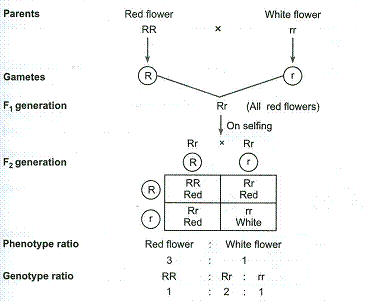 Mendel's law of dominance can be deduced from the above
cross. The hybrid is heterozygous containing both the alternative alleles (R
and r). However, only one trait, i.e. red colour appeared and the white
colour trait was suppressed in the F1 generation. So, we can
conclude that the red colour trait is dominant over the white colour trait.
This explains Mendel’s law of dominance.
Mendel's law of dominance can be deduced from the above
cross. The hybrid is heterozygous containing both the alternative alleles (R
and r). However, only one trait, i.e. red colour appeared and the white
colour trait was suppressed in the F1 generation. So, we can
conclude that the red colour trait is dominant over the white colour trait.
This explains Mendel’s law of dominance.
Q2. In one family, each of the four children has a different blood group. The mother is group A and the father is group B. Explain this pattern of inheritance with the help of a cross along with their genotypes.
Solution
A
cross is carried out between
the heterozygous father (for blood group B) and the heterozygous mother (for blood group A) to get four children with different blood groups.
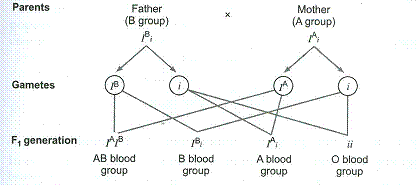 All the four blood groups are controlled by three allelic genes IA, IB,
i which exhibit an instance of multiple allelism. Both
IA and IB are dominant over i. However,
when together, both are dominant and show the phenomena of co-dominance, forming the blood group AB. Six genotypes are possible with the combination of these three alleles.
All the four blood groups are controlled by three allelic genes IA, IB,
i which exhibit an instance of multiple allelism. Both
IA and IB are dominant over i. However,
when together, both are dominant and show the phenomena of co-dominance, forming the blood group AB. Six genotypes are possible with the combination of these three alleles.
All the four blood groups are controlled by three allelic genes IA, IB,
i which exhibit an instance of multiple allelism. Both
IA and IB are dominant over i. However,
when together, both are dominant and show the phenomena of co-dominance, forming the blood group AB. Six genotypes are possible with the combination of these three alleles.
Q3. The male fruit fly and female fowl are heterogametic, while the female fruit fly and the male fowl are homogametic. Why are they called so?
Solution
The male fruit fly has XY sex chromosomes and produces two types of gametes. Hence, it is called heterogametic. A female fowl has ZW sex chromosomes,
thereby producing two types of gametes. Hence, it is called
heterogametic. The female fruit
fly has two X chromosomes, i.e. XX and produces similar gametes. Hence, it is called homogametic. Also,
the male fowl has two Z chromosomes and produces similar
gametes. Therefore, it is called homogametic.
Q4. Why did Mendel choose garden pea for his experiment? How did he make
sure that the plants were true breeding?
Solution
Mendel choose garden pea for his experiment because
of the following reasons:
1. It is an annual plant with a short lifecycle.
2. It has perfect bisexual flowers containing both
male and female parts.
3. The flowers are self-pollinating, and so, it is
easy to get a pure line for several generations.
4. It is easy to cross-pollinate the plant because
pollen from one plant can be introduced to the stigma of another plant by
removing of anthers.
5. Pea plant produces a large number of seeds in one
generation.
6. The plants can be easily raised, maintained and
handled.
7. Many easily detectable contrasting characters
were available.
Q5. What is aneuploidy?
Solution
The phenomenon of failure of segregation of two
homologous chromosomes of a particular pair during cell division as a result
of gain or loss of chromosome(s) is called aneuploidy.
Q6. Mention the type of allele which expresses itself only in a homozygous
state in an organism.
Solution
A recessive allele expresses itself only in the homozygous state in an
organism.
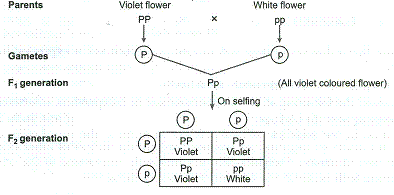
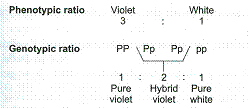
Q7. Work out F1 and F2 generation to explain the
inheritance of flower colour in Pisum sativum. Give the phenotypic and
genotypic ratios (start with pure breeding).
Solution
This is a case of Mendel's monohybrid cross.
Q8. Name one autosomal dominant and one autosomal recessive Mendelian
disorder in humans.
Solution
Huntington's disease is an autosomal dominant disorder and haemophilia
is an autosomal recessive disorder.
Q9. Mention the phenomenon of sex determination in the following cases:
(a) Male Drosophila - XY
(b) Female fowl - ZW
(c) Male grasshopper - XO
Solution
(a) Male heterogamety
(b) Female heterogamety
(c) Male heterogamety
Q10. When a tall pea plant was self-pollinated, one-fourth of the progeny was
dwarf. Give the genotype of the parent and dwarf progeny.
Solution
The genotype of the parent is Tt and the genotype of the dwarf progeny
is tt.
Q11. Define mutation. Name one physical and one chemical
mutagen.
Solution
Mutation is a rare, random, discontinuous, inheritable variation in
the amount or the structure of the genetic material in the genotype of an
organism.
Physical mutagen: UV rays
Chemical mutagen: 5-Bromouracil
Q12. Explain
how does trisomy of the 21st chromosome occurs in humans. List any
four characteristic features in an individual suffering from it.
Solution
Down’s syndrome is also known as Trisomy 21. It is
caused by the presence of an extra chromosome no. 21. Both the chromosomes of
the pair 21 pass into a single egg due to non-disjunction during oogenesis in
the mother’s ovary. Thus, the egg has 24 chromosomes instead of 23, and the
offspring has 47 chromosomes (45+XY in male and 45+XX in female) instead of
46 chromosomes (44+XX or XY).
Characteristic features
of Down’s syndrome:
(i) Short statured with small round head
(ii) Partially open mouth with protruding furrowed
tongue
(iii) Broad palm with characteristic palm crease
(iv) Slow mental development
Q13. During his
studies on genes in Drosophila which were sex-linked, T. H. Morgan found that the population phenotypic ratios deviated from the expected 9:3:3:1 ratio. Explain the
conclusion he arrived at.
Solution
(i) T.
H. Morgan observed that when the two genes in a dihybrid cross are located on the
same
chromosome, the proportion of parental gene combinations in the progeny was much higher than the non-parental or recombination of genes.
(ii) Morgan and his colleagues
found that when genes were grouped on the same chromosome, some genes are tightly linked and show less recombination.
(iii) When the genes are loosely linked, they show higher recombination.
Q14. (i) Why are grasshopper and Drosophila said
to show male heterogamety? Explain.
(ii) Explain female heterogamety with the help of an example.
Solution
(i) Drosophila exhibits XY type of sex determination. Males produce two types of sperms,
one having X chromosome and the other having Y chromosome, whereas females have
only X chromosome. Grasshoppers exhibit XO type of sex determination. Males produce two types of gametes, one with X chromosome and the other with no chromosome.
Thus, both show male heterogamety.
(ii) Female heterogamety can be seen in female birds. In these, the females have one Z and one
W chromosome, whereas males have a pair of Z chromosomes besides the autosomes.
Q15. For flower colour in pea, the allele for purple flower (P) is dominant over the allele for white flower (p). A purple-flowered plant therefore could be of genotype PP or Pp. What genetic cross would you make to determine the genotype of a purple-flowered plant? Explain how your cross gives you the correct genotype of the purple-flowered plant.
Solution
The genotype of a purple-flowered plant can be determined by conducting a test cross.
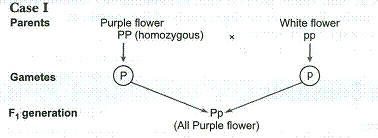 If the F1 generation produces all purple flowers, the parent would be homozygous dominant, i.e. PP.
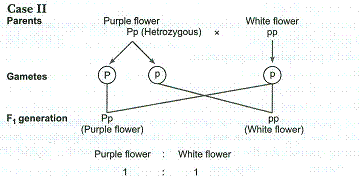 If the F1 generation produces purple and white flowers in a 1:1 ratio, the parent would be heterozygous, i.e. Pp.
If the F1 generation produces all purple flowers, the parent would be homozygous dominant, i.e. PP.
If the F1 generation produces purple and white flowers in a 1:1 ratio, the parent would be heterozygous, i.e. Pp.
Q16. Name the phenomenon which leads to situations like 'XO' abnormality in humans. How
do humans with 'XO' abnormality suffer? Explain.
Solution
Absence of one
X chromosome leads to ‘XO’ abnormality. The individuals are sterile females with rudimentary ovaries. They have shield-shaped thorax, webbed neck, show poor development of breasts, short stature, small uterus and puffy fingers.
Q17. A haemophilic son was born to normal parents. Give the
genotypes of the parents.
Solution
Father: 44
+ XY Mother: 44
+ XXh
(Xh = X chromosome
with gene for haemophilia)
Q18. Write the genotype of (i) an individual who
is a carrier of the sickle cell anaemia gene but apparently unaffected, and (ii) an individual affected with
the disease.
Solution
(i) An individual who
is a carrier of the sickle cell anaemia gene but apparently unaffected: HbAHbS
(ii) An individual
affected with the disease: HbSHbS
Q19. (a)
You are given tall pea plants with yellow seeds whose genotypes are
unknown. How would you find the genotype of these plants? Explain with the help of a cross.
(b) Identify a, b and c in the table
given
below:
Sr.
No.
Pattern
of inheritance
Monohybrid
F1 phenotypic expression
1.
Co-dominance
a
2.
b
The progeny resembled only one of the parents
3.
Incomplete dominance
c
Solution
(a) Test cross will be performed to know the genotype of
the given tall pea plants with
yellow seeds.
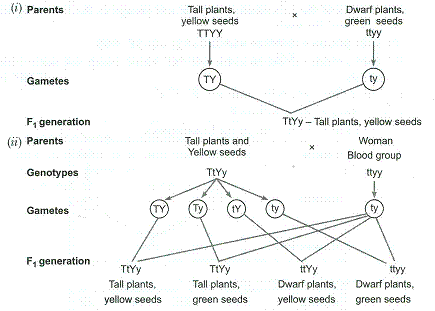 If
all the plants of the F1
generation are tall with yellow seeds, then the parent is homozygous dominant (Case i). If the plants in the F1 generation are
in the ratio 1:1:1:1, then the parent plant is heterozygous dominant.
(b)
a: Both the forms of a trait are equally expressed in the
F1 generation.
b:
Dominance
c:
Phenotypic expression of the
F1 generation is somewhat intermediate between the two parental forms of a trait.
If
all the plants of the F1
generation are tall with yellow seeds, then the parent is homozygous dominant (Case i). If the plants in the F1 generation are
in the ratio 1:1:1:1, then the parent plant is heterozygous dominant.
(b)
a: Both the forms of a trait are equally expressed in the
F1 generation.
b:
Dominance
c:
Phenotypic expression of the
F1 generation is somewhat intermediate between the two parental forms of a trait.
If
all the plants of the F1
generation are tall with yellow seeds, then the parent is homozygous dominant (Case i). If the plants in the F1 generation are
in the ratio 1:1:1:1, then the parent plant is heterozygous dominant.
(b)
a: Both the forms of a trait are equally expressed in the
F1 generation.
b:
Dominance
c:
Phenotypic expression of the
F1 generation is somewhat intermediate between the two parental forms of a trait.
Q20. A human being suffering from Down's syndrome shows trisomy
of 21st chromosome. Mention the cause of this chromosomal
abnormality.
Solution
In Down’ syndrome, due to non-disjunction, the 21st pair of
chromosome fails to separate during oogenesis. Therefore, the egg possesses
24 chromosomes instead of 23. When the egg fuses with a sperm, the zygote has
three copies of chromosome 21 resulting in trisomy.
Q21. Why is it that the father never passes on the gene for haemophilia to
his sons? Explain.
Solution
Haemophilia is a sex-linked recessive disease. The defective gene is
present on the X chromosome only and not on the Y chromosome. As the father
always contributes a Y chromosome and never passes an X chromosome to his
son, the gene for haemophilia can never be passed from a father to his son.
Q22. Explain the sex determination mechanism in humans. How is it different in birds?
Solution
The XY type of sex determination is seen
in humans. Both males and females have equal number of chromosomes. Males have one X chromosome and a smaller Y chromosome, while females have a pair
of X chromosomes. Hence,
males have autosomes and XY sex chromosomes, while females have autosomes and XX
sex chromosomes. This shows male heterogamety.
Female heterogamety is observed
in birds. They exhibit ZW type of sex determination. Both males and
females have equal number of chromosomes. Female
birds have one Z and one W chromosome, whereas males have a pair
of Z chromosomes.
Q23. What is gene locus?
Solution
Gene
locus is the particular location or position where a gene is located on a
chromosome.
Q24. (i) State
the principle of independent assortment.
(ii) How
would the following affect the phenomenon of independent assortment?
(a)
Crossing over (b) Linkage
Solution
(i) The law of independent assortment states that
the alleles of different characters located in different pairs of homologous
chromosomes are independent of one another in their segregation during gamete
formation and in coming together into the offspring by fertilisation, both
processes occurring randomly.
(ii) (a) Crossing over:
Crossing over influences linked genes. As a result, 50% recombination is
obtained in the test cross progeny.
(b) Linkage: It influences recombination which is
less than 50%.
Q25. Explain the chromosomal theory of inheritance.
Solution
The chromosomal theory of
inheritance was proposed independently by Walter Sutton and Theodore Boveri
in 1902. According to this theory,
1. As the sperm and the
egg cells serve as a connecting link from one generation to the other, all
the hereditary characters must be carried in them.
2. The hereditary factors
are present in the nucleus of cells.
3. Like Mendelian alleles,
chromosomes are also found in pairs.
4. The sperm and egg
having haploid sets of chromosomes fuse to re-establish the diploid state.
5. The genes are carried
on the chromosomes.
6. Homologous chromosomes
synapse during meiosis and get separated to pass into different cells. This
forms the basis of segregation and independent assortment.
Q26. The map distance in
certain organisms between gene A and B is 4 units, B and C is 2 units and gene C and D is 8 units. Which one of these gene pairs will show more recombination frequency? Give reasons in support of your
answer.
Solution
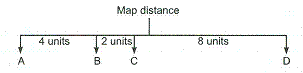 The recombination frequency is directly proportional
to the distance between the genes.
In the above example, the distance between
genes C and D is more, i.e. 8 units. So, the recombination frequency will be more between them.
The recombination frequency is directly proportional
to the distance between the genes.
In the above example, the distance between
genes C and D is more, i.e. 8 units. So, the recombination frequency will be more between them.
Q27. Why in a test cross did Mendel cross a tall pea pant with a dwarf pea plant
only?
Solution
In a test cross, Mendel crossed a tall pea plant
with only a dwarf pea plant to determine the genotype of the F2 generation.
Q28. What is non-disjunction?
Solution
The inability of homologous chromosomes to separate out during
meiosis in an individual is called non-disjunction. Due to this, some gametes
receive both the chromosomes, while the rest do not receive any
chromosomes.
Q29. Name a disorder, give the karyotype and write the symptoms where a human male suffers as a result of an additional X-chromosome.
Solution
In
Klinefelter's syndrome, a human male
suffers as a result of an additional X-chromosome. His karyotype is 44+XXY.
Symptoms of Klinefelter's syndrome are
(i) The sex of the individual is male, but the
person possesses feminine characters.
(ii) Gynaecomastia, i.e. development of breasts.
(iii) Poor beard growth and often sterile.
(iv) Feminine pitched voice.
Q30. A garden pea plant (A) produced inflated yellow pod,
and another plant (B) of the same species produced constricted green pods.
Identify the dominant traits.
Solution
Inflated green pod is the dominant trait and constricted yellow pod is
the recessive trait.
Q31. Define heterozygous and homozygous.
Solution
When dissimilar or different pairs of alleles are
present for a character, it is called heterozygous condition, e.g. Tt.
When similar pairs of alleles are present for a
character, it is called homozygous, e.g.
TT.
Q32. A haemophilic man marries a normal homozygous woman.
What is the probability that their daughter will be haemophilic?
Solution
A haemophilic man (XhY) marries a normal homozygous woman
(XX). So, their daughter would have the genotype (XhX). As
haemophilia is a recessive trait, the daughter would always be a carrier of
the trait and can never be haemophilic.
Q33. What is
crossing over?
Solution
Crossing over is the mutual exchange of the
corresponding segments of the adjacent paternal and maternal chromatids of
the synapsed homologous chromosomes in the pachytene stage of meiosis-I,
producing new combinations of genes.
Q34. A non-haemophilic couple was informed by their doctor that there is a possibility of a haemophilic child
to be born to them. Explain the basis on which the doctor conveyed this information. Give the genotypes and the phenotypes of all possible children who could be born
to them?
Solution
The doctor
must have conveyed this information
on the basis of pedigree analysis. Pedigree analysis
is a strong tool used to trace the inheritance of a specific trait, abnormality or a disease. Because
both
the parents are non-haemophilic, their genotypes will be
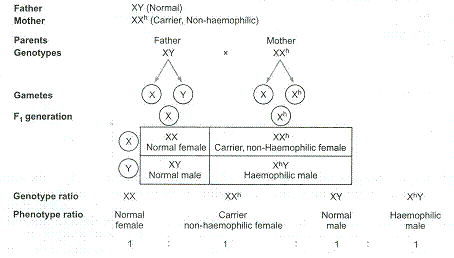
Q35. (i) How does a chromosomal disorder differ from a Mendelian disorder?
(ii) Name any two chromosomal aberration-associated disorders.
(iii) List the characteristics of disorders mentioned above which help in their diagnosis.
Solution
(i) Difference between Mendelian disorder and chromosomal disorder
Mendelian disorder
Chromosomal disorder
1. This disorder is mainly due to alteration or mutation in a single gene.
1. This disorder is caused due to absence or excess or abnormal arrangement of one or more chromosomes.
2. It follows Mendel's principles of inheritance.
2. It does not follow Mendel's principles of inheritance.
3. It may be recessive or dominant in nature.
3. It is always dominant in nature.
4. Examples: Haemophilia, sickle-cell anaemia
4. Example: Turner's syndrome
(ii) Two chromosomal aberration-associated disorders are Down's syndrome and Klinefelter's syndrome.
(iii) (a) Down's syndrome: The individuals have overall masculine development, but they express feminine characteristics such as development of breasts, i.e. gynaecomastia. They are sterile.
(b) Klinefelter's syndrome: The females are sterile as ovaries are rudimentary. Other secondary sexual characters are also lacking.
Q36. Mendel crossed plants which bred true for yellow seeds with plants which
bred true for green seeds. All seeds in the F1 generation were yellow. Work out the inheritance involved in this
cross by using symbols for the trait. Which trait was dominant?
Solution
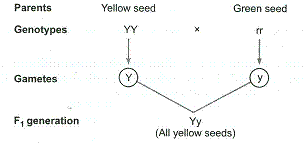 We can conclude that the yellow seed colour is
dominant over green because it is expressed in the F1 generation.
We can conclude that the yellow seed colour is
dominant over green because it is expressed in the F1 generation.
Q37. Inheritance pattern of ABO blood group in humans shows dominance, co-dominance and multiple allelism. Explain each concept with the help of blood group genotypes.
Solution
Dominance: The alleles IA and IB
are dominant over allele i as IA and IB form antigens A
and B, respectively, but i does not form any
antigen.
Co-dominance: Both the alleles IA
and IB are co-dominant as both of them are able to express themselves in the presence of each other in blood group AB (IAIB) by forming antigens A and B.
Multiple allelism: It is the phenomenon of occurrence of a gene in more than two allelic
forms on the same locus. The
ABO blood group in humans is determined by three
different allelic forms IA, IB and i.
The above three explanations prove that the
inheritance of ABO blood group in humans shows dominance, co-dominance and
multiple allelism.
Genotype
Surface
antigen
Blood
group
IAi
A
A
IAIA
A
A
IBi
B
B
IBIB
B
B
IAIB
AB
AB
ii
-
O
Q38. (a) Sickle-cell anaemia in humans is a result of point mutation. Explain.
(b) Write the genotypes of both the parents who have produced a sickle-celled anaemic offspring.
Solution
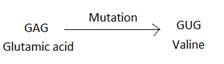
(a) In sickle-cell anaemia, due
to point mutation, there is a substitution of a single nitrogen
base at the sixth codon of the globin chain of haemoglobin.
 (b) The genotypes of both
the parents would be HbAHbS and HbAHbS.
(b) The genotypes of both
the parents would be HbAHbS and HbAHbS.
(b) The genotypes of both
the parents would be HbAHbS and HbAHbS.
Q39. What are
linked genes? How can a pair of linked genes be identified?
Solution
The genes
which tend to transmit together as a unit as they are closely located on the
same chromosome are called linked genes. The linked genes modify the
Mendelian dihybrid ratio from 9:3:3:1 to 3:1 and modify the dihybrid test
ratio from 1:1:1:1:1 to 1:1.
Q40. (a) Explain a monohybrid cross taking seed coat colour as a trait in Pisum sativum. Work out the cross up to the F2 generation.
(b) State the laws of inheritance which can be derived from such a cross.
(c) How is the phenotypic ratio of the F2 generation different in a dihybrid cross?
Solution
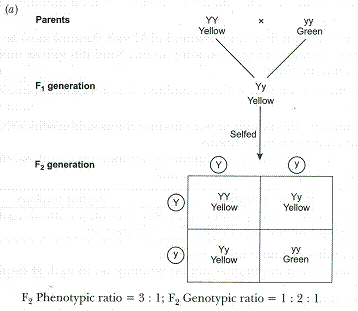 (b) Law of dominance: When two alternative forms of a trait
or character (genes or alleles) are present in an organism, only one factor
expresses itself in the F1 progeny and is called dominant and the
other which remains masked is called recessive.
Law of segregation:
The factors or alleles of a pair segregate from each other during gamete
formation such that a gamete receives only one of the two factors. They do
not show any blending.
(c) Phenotypic ratio of the F2 generation
in a monohybrid cross is 3:1, whereas in a dihybrid cross, it is 9:3:3:1.
(b) Law of dominance: When two alternative forms of a trait
or character (genes or alleles) are present in an organism, only one factor
expresses itself in the F1 progeny and is called dominant and the
other which remains masked is called recessive.
Law of segregation:
The factors or alleles of a pair segregate from each other during gamete
formation such that a gamete receives only one of the two factors. They do
not show any blending.
(c) Phenotypic ratio of the F2 generation
in a monohybrid cross is 3:1, whereas in a dihybrid cross, it is 9:3:3:1.
Comments
Post a Comment