Q1. Describe
three ways in which fertilisation of the human ovum by a sperm can be
prevented.
Solution
Fertilisation of the human ovum by a sperm can be prevented by
the following methods:
(a)
Condoms made of thin rubber or latex sheath act as barriers. These are used
to cover the penis in the male or vagina and cervix in females.
(b)
Diaphragm, cervical caps and vaults are barriers made of rubber which are
introduced in the female reproductive tract to cover the cervix.
(c)
Spermicidal creams, jellies and foams are introduced in the vagina to kill
sperms.
Q2. Mention any two events which are
inhibited by the intake of oral contraceptive pills to prevent pregnancy in
humans.
Solution
Two
events which are inhibited by the intake of oral contraceptive pills to
prevent pregnancy in humans are ovulation and implantation.
Q3. What
is amniocentesis? Why has the government imposed a statutory ban in spite of its
importance in the medical field?
Solution
Amniocentesis
is a foetal sex determination test based on the
chromosomal pattern in the amniotic fluid surrounding the developing embryo.
Amniocentesis is used for sex determination which most people get done to
kill the female foetus. Therefore, it has been banned.
Q4. How
do surgical procedures prevent conception in humans? Mention the way it is
achieved in human males.
Solution
Surgical
procedures block gamete transport and thereby prevent conception. In human
males, the sterilisation procedure is called
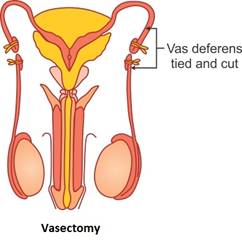
vasectomy, i.e. a small part of the vas deferens is removed or tied up
through a small incision on the scrotum.
Q5. Describe the different methods
of embryo transfer.
Solution
An embryo is transferred into the uterus or fallopian
tube of the females in the following ways:
(i) The zygote or embryo with up
to 8 blastomeres is transferred into the fallopian
tube. This is called zygote intra-fallopian transfer (ZIFT).
(ii)
An embryo with more than 8 blastomeres is
transferred into the uterus. This is called intra-uterine transfer (IUT).
Q6. A mother of a one-year-old daughter wanted to space her second child. Her doctor suggested
Copper T. Explain its contraceptive actions.
Solution
Copper T is an ideal contraceptive device for human females because
(i) Cu ions released suppress sperm motility and
the fertilising capacity of sperms.
(ii) They increase phagocytosis of sperms within the uterus.
Q7. Write
a note on chorionic villus sampling (CVS).
Solution
Chorionic
villus sampling (CVS) is a new technique which can
be used during the 8th to 10th week of pregnancy when abortion is safe for
the woman. For CVS, cells are sucked into a catheter passed through the
vagina and cervix. This technique provides a mass of rapidly dividing foetal cells, thus facilitating the examination of
chromosomal disorders.
Q8. Expand ZIFT and RTI.
Solution
ZIFT: Zygote Intra-Fallopian Transfer
RTI: Reproductive Tract Infection
Q9. Why is tubectomy
considered a contraceptive method?
Solution
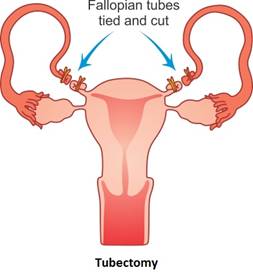
Tubectomy involves cutting a piece of the fallopian tube and
tying its ends. This way, the sperms are not able to reach the egg and it
acts as a contraceptive method.
Q10. STDs are a threat to reproductive health. Describe any two
such diseases and suggest preventive measures.
Solution
Diseases or infections
which are transmitted through sexual intercourse with infected persons are
called sexually transmitted diseases or STDs.
Gonorrhoea caused by Neisseria gonorrhoeae
(bacteria) and Hepatitis B caused by Hepatitis B virus are examples of
sexually transmitted diseases.
STDs can be prevented by
following some simple practices:
(i) Avoid sexual contact with
HIV-infected people.
(ii) Avoid using syringes, needles, razors and toothbrushes
used by AIDS patients.
(iii) Blood should be tested properly for HIV before blood
donation.
(iv) Breastfeeding should be avoided by an HIV-infected
mother.
(v) Addiction of drugs should be avoided.
Q11. Briefly
explain IVF and ET. What are the conditions in which these methods are
advised?
Solution
IVF
refers to in vitro fertilisation and ET refers to embryo transfer. Gametes
from the male and female are collected hygienically and induced to fuse in
the laboratory set up under simulated conditions. The zygote formed is
collected and is introduced into the uterus of a host or surrogate mother at
the appropriate time (secretory phase). Early
embryos (up to 8 cells) are generally transferred to the fallopian tube,
whereas embryos with more than 8 cells are transferred to the uterus.
Q12. Describe vasectomy and
tubectomy with diagrams.
Solution
Vasectomy
and tubectomy are permanent methods of
contraception. They are also known as sterilisation
techniques. These methods are generally advised to the male or female partner
as a terminal method to prevent any more pregnancies. It blocks gamete
transport and thereby prevents conception.
In
vasectomy, a small part of the vas deferens is removed and then tied up
through a small incision on the scrotum.
 In
tubectomy, a small part of the fallopian tube is
removed and then tied up through a small incision in the abdomen or through
the vagina. These techniques are highly effective, but their reversibility is
poor.
In
tubectomy, a small part of the fallopian tube is
removed and then tied up through a small incision in the abdomen or through
the vagina. These techniques are highly effective, but their reversibility is
poor.
In
tubectomy, a small part of the fallopian tube is
removed and then tied up through a small incision in the abdomen or through
the vagina. These techniques are highly effective, but their reversibility is
poor.
Q13. Within
what age group are sexually transmitted diseases (STDs) reported to be very
high? Mention three practices to avoid them.
Solution
In the age group of 15-24
years, STDs are reported to be very high. Following are the three practices to avoid them:
(i)
Avoid sex with unknown partners or multiple partners.
(ii) Always use condoms during
coitus.
(iii)
In case of any doubt, medical help should be taken for early detection.
Q14. What are the assisted reproductive techniques practised to help infertile couples? Describe any three techniques.
Solution
Infertile
couples can be assisted to have children through certain special techniques
called assisted reproductive techniques (ART), which are as follows:
(i)
Test-tube baby programme: In this method, ova from
the wife/donor (female) and sperms from the husband/donor (males) are
collected and induced to form a zygote under simulated conditions in the
laboratory. This process is called in
vitro fertilisation (IVF).
The baby produced by
conceiving in a culture dish and nursing in the uterus is called a test-tube
baby. The test-tube baby programme involves either
ZIFT (zygote intra-fallopian transfer) in which the zygote or the early
embryo (up to the 8 blastomere stage) is
transferred into the fallopian tube of females or IUT (intra uterine
transfer) in which the embryo with more than 8 blastomeres
is transferred into the uterus to complete further development of the zygote
or embryo.
(ii)
Gamete intra-fallopian transfer (GIFT): It
is a method used in females who cannot produce ova but can provide a suitable
environment for fertilisation and further
development of the embryo in the oviducts.
(iii)
Intra-cytoplasmic sperm injection (ICSI): In intra-cytoplasmic sperm injection (ICSI), a sperm is directly
injected into the ovum placed in a nutrient broth.
(iv)
Artificial insemination (AI): Artificial
insemination is used in those females where the husband is either unable to
inseminate the female or has very low sperm counts in the ejaculates. In such
cases, the semen of the husband/donor male is first collected and is then
artificially introduced either in the vagina or in the uterus (intra-uterine
insemination or IUI) of the female.
Q15. Expand the following:
(i) ART (ii) GIFT (iii) ICSI (iv) RTI (v) lUI
Solution
(i) ART: Assisted Reproductive Technology
(ii)
GIFT: Gamete Intra-Fallopian Transfer
(iii)
ICSI: Intra-Cytoplasmic Sperm Injection
(iv)
RTI: Reproductive Tract Infections
(v)
lUI: Intra-Uterine Insemination
Q16. How
do the following contraceptives act to prevent unwanted pregnancy in human
females?
(i)
Intra-uterine devices (IUDs)
(ii)
Saheli
Solution
(i) Intra-uterine devices are inserted in the uterus
through the vagina and are presently available as non-mediated IUDs,
copper-releasing IUDs and hormone-releasing IUDs. They increase phagocytosis of sperms within the uterus and the Cu ions
released suppress sperm mobility along with the fertilising
capacity of the sperms. On the other hand, hormone-releasing IUDs make the
uterus unsuitable for implantation and the cervix hostile to sperms.
(ii)
Saheli is an oral contraceptive for females
containing a non-steroidal preparation. It is a 'once a week' pill with few
side-effects and high contraceptive value.
Q17. Describe three ways in which
fertilisation of the human ovum by a sperm can be prevented.
Solution
Fertilisation
of the human ovum by a sperm can be prevented by the following methods:
(a)
Condoms made of thin rubber or latex sheath act as barriers. These are used
to cover the penis in males or vagina and cervix in females.
(b)
Diaphragm, cervical caps and vaults are barriers made of rubber which are
introduced in the female reproductive tract to cover the cervix.
(c)
Spermicidal creams, jellies and foams are introduced in the vagina to kill
sperms.
Q18. Describe the lactational amenorrhea method of birth control.
Solution
Lactational amenorrhea is based on the principle that during the period of intense
lactation after parturition, the menstrual
cycle or ovulation does not occur.
Q19. The present population growth
rate in India is alarming. Suggest ways to check it.
Solution
Ways
to check population growth:
(i) By increasing marriageable age
(ii) By promoting the use of
birth control measures
(iii)
By educating people about the consequences of uncontrolled population growth
Q20. Describe the various methods
of birth control.
Solution
The methods of birth control
are divided into the following categories:
(i)
Natural/traditional methods: These are natural methods which work on the
principle of avoiding the meeting of the ovum and the sperm. It includes
periodic abstinence, coitus interruptus and lactational amenorrhea.
(ii) Barrier methods: These
methods prevent the contact of the sperm and the ovum by using barriers. Such
methods are available for both males and females. These include condoms,
diaphragms, cervical caps, vaults, spermicidal creams, jellies and foams.
(iii) Intra-uterine devices:
These devices are inserted by doctors in the uterus through the vagina. There
are three types of IUDs available which include non-medicated IUDs,
copper-releasing IUDs and hormone-releasing IUDs.
(iv) Oral contraceptive: This
involves uptake of hormonal preparations of either progestogen
or progestogen-oestrogen combinations in the form
of pills.
(v) Injections and implants: Progestogen or progestogen-oestrogen
combination can also be used by females as injections or implants under the
skin.
(vi)
Surgical methods: These are terminal and permanent methods which block the
transport of gametes, thereby preventing conception. This is achieved by
vasectomy in males and tubectomy in females.
Q21. What is meant by artificial insemination?
Solution
Artificial insemination is a technique by which the semen collected
from the husband or a healthy donor is artificially introduced either into the vagina or into the uterus of the female.
Q22. What
is the significant role of MTP in human population?
Solution
MTP or Medical Termination of Pregnancy is done
to get rid of unwanted pregnancies due to
(i)
Casual unprotected intercourse
(ii) Failure of the contraceptive
used during coitus
(iii) Rape
It is also
essential in cases where continuation of pregnancy could pose a threat to the
life of either the mother or foetus or both.
Q23. Explain
the zygote intra-fallopian transfer technique (ZIFT). How is intra-uterine
transfer technique (IUT) different from it?
Solution
Zygote intra-fallopian transfer technique
(ZIFT) is a technique in in vitro fertilisation
where the zygote or early embryo with up to 8 blastomeres
is transferred into the fallopian
tube to complete its further
development.
Intra-uterine
transfer (IUT) technique is different from ZIFT as the embryos with more than
8 blastomeres are transferred into the uterus in
IUT.
Q24. What are the commonly used
barrier methods of contraception?
Solution
Condoms,
diaphragms, cervical caps and vaults are the commonly used barrier methods of
contraception.
Q25. What do you mean by reproductive
health? Mention the different ways in which people are made aware of the
significance of reproductively healthy society.
Solution
Reproductive health means
total well-being in all aspects of reproduction, i.e. physical, emotional, behavioural, social and physiological.
Following measures are to be
taken to make people aware of reproductively healthy society:
(i) Providing infrastructural facilities and professional
expertise to attain reproductive health.
(ii) Educating people about
birth control methods, care of pregnant mothers, importance of breast
feeding, safe and hygienic sexual practices and safeguards against STDs.
(iii) Introduction of sex
education in schools to give proper information to young minds about
sex-related aspects.
(iv) Help of audio-visual and
print-media to create awareness among
people about reproduction-related aspects.
(v) Awareness of problems due
to population explosion, social evils such as sex abuse and sex-related
crimes.
(vi)
Statutory ban on amniocentesis to legally check female foeticides.
Q26. Describe the technique by which
a genetic disorder in a developing foetus can be detected.
Solution
Amniocentesis
is a technique by which a genetic disorder in a developing foetus can be detected. This is based on the chromosomal
pattern in the amniotic fluid surrounding the developing embryo. The amniotic
fluid contains cells and molecules shed by the foetus.
The chromosomes of foetal cells can also be used to
find out the sex of the foetus. So, if an
abnormality is found, the mother should get the foetus
aborted.
Q27. How
are assisted reproductive technologies helpful to humans? How are ZIFT and
GIFT different from intra-uterine transfers? Explain.
Solution
The
infertile couples could be assisted to have children through certain special
techniques known as assisted reproductive technologies (ART).
ZIFT:
The zygote or early embryo with up to 8 blastomeres
is transferred into the fallopian tube. This is called zygote intra-fallopian
transfer (ZIFT).
GIFT:
Gamete intra-fallopian transfer is the transfer of an ovum collected from a
donor into the fallopian tube of another female who cannot produce one but
can provide a suitable environment for fertilisation
and further development of the embryo.
Intra-uterine
transfer (IUT) refers to the introduction of an embryo with more than 8 blastomeres into the uterus of a female to complete its
further development.
Q28. Why intensely lactating mothers do not generally conceive?
Solution
Intensely lactating mothers do not generally conceive due to the suppression of gonadotropins.
Q29. At the time of Independence,
the population of India was 350 million, which exploded to over 1 billion by
May 2000. List any two reasons for this rise in population and any two steps
taken by the government to check this population explosion.
Solution
Two reasons for increase in population are
(i)
A rapid decline in the death rate, maternal mortality rate and infant
mortality rate.
(ii) Increase in the number of
people of reproducible age.
Two steps for checking
population explosion:
(i)
Statutory raising of marriageable age of females to
18 years and males to 21 years.
(ii)
Incentives given to couples with small families.
Q30. In
GIFT, gametes are transferred to the fallopian tube. Can gametes be
transferred to the uterus to achieve the same result? Explain.
Solution
The
uterine environment is not ideal for the survival of gametes. If directly
transferred to the uterus, gametes will undergo degeneration or could be phagocytosed, and hence, viable zygotes would not be
formed.
Comments
Post a Comment