Q1. How many sperms will be produced from 10 primary spermatocytes
and how many eggs will be produced from 10 primary oocytes?
Solution
10 primary spermatocytes will produce 40 sperms and
10 primary oocytes will produce 10 eggs.
Q2. Describe
the functions of human placenta.
Solution
Functions of human
placenta:
1.
Nutritive organ: Food materials pass from the mother’s blood into the foetal
blood through the placenta.
2.
Digestive organ: The trophoblast of the placenta digests proteins before
passing them into foetal blood.
3.
Respiratory organ: Oxygen diffuses from the maternal blood into foetal blood
through the placenta. Carbon dioxide diffuses from the foetal blood into the
maternal blood also through the placenta for elimination by the mother’s
lungs.
4.
Excretory organ: Nitrogenous wastes pass from the foetal blood into the
maternal blood through the placenta for elimination by mother’s kidneys.
5.
Endocrine organ: Placenta secretes (hCG), estrogen, progesterone and human
placental lactogen.
6.
Storage organ: The placenta stores glycogen for the foetus before liver is
formed.
7.
Barrier: Many substances pass from the mother to the foetus via placenta and
cause abnormal development in the developing foetus.
Q3. Breast fed infants have a better immunity than
bottle fed ones. Why?
Solution
The first secretion from the breast, colostrum, is
rich in antibodies, which provide passive immunity to the child. So, breast fed infants have a better immunity than
bottle fed ones.
Q4. Assuming a
spermatogonial cell has 30 chromosomes, how many chromosomes will be formed
in:
a) The primary
spermatocyte
b) a spermatid derived
from the cell
Justify
your answer.
Solution
a) 30 chromosomes will be
formed in the primary spermatocyte since primary spermatocyte is formed by
mitosis of spermatogonial cell.
b) 15 chromosomes will be
formed in spermatid derived from the cell since spermatids are
formed by meiosis of spermatocytes.
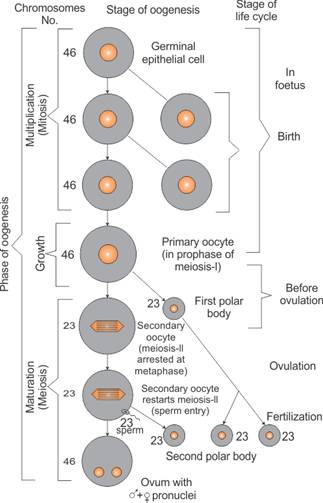
Q5. Give a schematic labelled diagram to represent oogenesis (without description).
Solution
Stages in oogenesis
Q6. Give reason for the following:
(a) The first half of the menstrual cycle is called
follicular phase as well as proliferative phase.
(b) The second half of the menstrual cycle is called
luteal phase as well as secretory phase.
Solution
(a) During follicular phase, primary follicles
transform into Graafian follicle under FSH stimulation. Graafian follicles
secrete estrogens with stimulate enlargement of endometrium of uterus. So,
the first half of the menstrual cycle is called follicular phase as well as
proliferative phase.
(b) During luteal phase, corpus luteum is fully
formed and secretes a large quantity of progesterone. So, the second half of
the menstrual cycle is called luteal phase as well as secretory phase.
Q7. Given
below are the events in human reproduction. Write them in the correct
sequential order.
Insemination,
Gametogenesis, Fertilization, Parturition, Gestation, Implantation.
Solution
Correct
order of events in human reproduction:
Gametogenesis,
Insemination, Fertilization, Implantation, Gestation, Parturition.
Q8. (a)
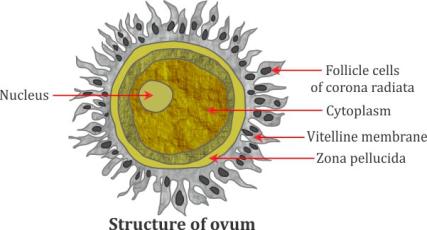
Draw a diagram of the structure of a human ovum surrounded by corona radiata,
label the following parts:
(i)
Ovum (ii) Plasma membrane (iii) Zona pellucida
(b)
State the function of zona pellucida.
Solution
(a) Structure of a human ovum
 (b) Function of
zona pellucida:
A capacitated sperm passes through the corona radiate to
reach the zona pellucida. One of the glycoproteins of zona pellucida, ZP3
functions as a sperm receptor and binds a complementary molecule on the
surface of the sperm head. Binding of the sperm head to the receptor molecule
ZP3 induces the acrosome reaction of the sperm to release its hydrolytic
enzymes by exocytosis.
(b) Function of
zona pellucida:
A capacitated sperm passes through the corona radiate to
reach the zona pellucida. One of the glycoproteins of zona pellucida, ZP3
functions as a sperm receptor and binds a complementary molecule on the
surface of the sperm head. Binding of the sperm head to the receptor molecule
ZP3 induces the acrosome reaction of the sperm to release its hydrolytic
enzymes by exocytosis.
(b) Function of
zona pellucida:
A capacitated sperm passes through the corona radiate to
reach the zona pellucida. One of the glycoproteins of zona pellucida, ZP3
functions as a sperm receptor and binds a complementary molecule on the
surface of the sperm head. Binding of the sperm head to the receptor molecule
ZP3 induces the acrosome reaction of the sperm to release its hydrolytic
enzymes by exocytosis.
Q9. Where are fimbriae present
in human female reproductive system? Give their function.
Solution
The funnel-shaped proximal
part of the fallopian tube is called infundibulum. Its margin bears motile,
finger-like processes called fimbriae. The fimbriae bear cilia that beat
towards the operature (called ostium) to direct the release of egg (from
ovary) into the infundibulum.
Q10. Mention the name and role of
hormones which are involved in regulation of gamete formation in human males.
Solution
Hormones involved in
regulation of gamete formation in human males:
GnRH:
Gonadotropin-releasing hormone (GnRH) stimulates adenohypophysis to secrete
gonadotrophins.
GSH:
Glutathione (GSH) stimulates Sertoli cells to secrete factors while help in
spermatogenesis.
ICSH: Interstitial
Cell Stimulating Hormone (ICSH) stimulates interstitial cells to secrete
testosterone.
Q11. What is colostrum?
Solution
Colostrum
is a thin, yellowish, opalescent fluid released after birth from the mother’s
breast for 2 to 3 days. It is also called foremilk.
Q12. Explain why all
copulations do not result in pregnancy.
Solution
Fertilization takes
place in the fallopian tube. The copulation is timed such that the sperms
reach the fallopian tube when ovum is still there and will then only be able
to cause effective fertilization. Hence, all copulations do not result in
pregnancy.
Q13. Differentiate between menarche and menopause.
Solution
The beginning of first menstrual cycle at puberty in human
females is called menarche. The cessation of menstrual cycle in women around
50 years of age is called menopause.
Q14. Where is morula formed in humans? Explain the
process of its development from zygote?
Solution
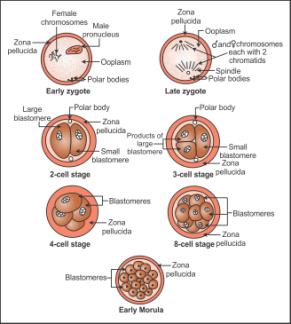
As the human zygote passes through the fallopian tube to the uterus,
cleavage occurs. The cleavage is holoblastic and it divides the blastomeres
completely into daughter cells. The first cleavage takes place about 30 hours
after fertilization. It is meridional, coinciding with the animal-vegetal
pole axis. It produces two blastomeres, one slightly larger than the other.
The second cleavage occurs within 60 hours after fertilization. It is at
right angles to the plane of the first, and divides each blastomere into two
by forming a mitotic spindle in each. Third cleavage takes place about 72
hours after fertilization. Subsequent cleavage divisions follow one after
another in an orderly manner, but in a less
precise orientation. Cleavage produces a solid ball of small blastomeres. The
embryo now looks like a mulberry, and is known as morula. It refers to the
lobed surface of the embryo at this stage.
Q15. Give the function of:
(a) Corpus luteum (b) Endometrium
Solution
(a)
Corpus luteum: It secretes progesterone which
prepares endometrium of the uterus for implantation and normal development of
the foetus.
(b)
Endometrium: It undergoes cyclic changes during
menstrual cycle and prepares itself for implantation of the blastocyst.
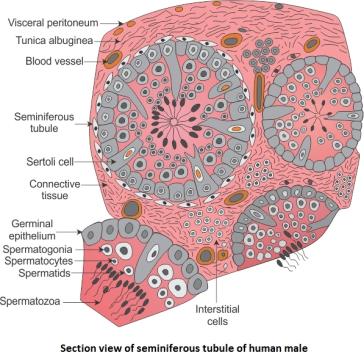
Q16. Draw a labelled section view of seminiferous
tubule of a human male.
Solution
Section view of seminiferous
tubule of a human male
Q17. Failure of testes to descend into scrotal sacs leads
to sterility. Why?
Solution
High temperature of the abdomen kills the spermatogenic
tissue of the testes. Thus, no sperms are formed. Hence, failure of testes to
descend into scrotal sacs leads to sterility.
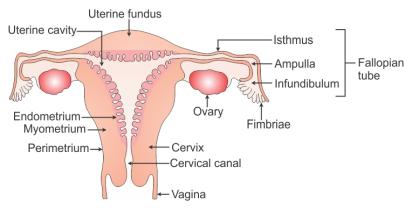
Q18. Draw a labelled diagram of
the reproductive system in a human female.
Solution
Reproductive system in a
human female
Q19. Nature has developed its
own mechanism to restrict the number of eggs fertilised per cycle in humans.
Justify.
Solution
Only one mature ovum is
released per cycle of menstruation in human females. In this way, nature has
developed its own mechanism to restrict the number of eggs fertilised per
cycle in humans.
Q20. Name the muscular and the glandular layers of human uterus.
Which one of these layers undergoes cyclic changes during menstrual cycle?
Name the hormone essential for the maintenance of this layer.
Solution
(i)
The muscular layer of human uterus is called myometrium and the glandular
layer is called endometrium.
(ii)
Endometrium undergoes cyclic changes during the menstrual cycle.
(iii) Progesterone is essential for the maintenance of
endometrium.
Q21. Both vaccine and colostrum produce immunity. Name the
type of immunity produced by these.
Solution
Vaccine produces active immunity and colostrum
produces passive immunity.
Q22. What is parturition? Which hormones are involved in it?
Solution
Parturition
is the act of expelling the fully developed young one (foetus) from the
mother's uterus at the end of gestation period. Oxytocin and relaxin hormones
are involved in parturition.
Q23. Three of the steps of neuro-endocrine mechanism in
respect of parturition are mentioned below.
Write the missing steps in proper sequence.
(a) Signals originate from fully developed foetus
and placenta.
(b) _____________.
(c) _____________.
(d) Oxytocin causes strong uterine contraction.
(e) Uterine contraction stimulates further secretion
of oxytocin.
(f) _____________.
Solution
(b) Foetal ejection reflex
(c) The reflex triggers release of oxytocin
(f) Expulsion of the baby out through the birth
canal.
Q24. T.S. of mammalian testis revealing seminiferous
tubules shows different types of cells.
(i) Name the types of cells of germinal epithelium.
(ii) Name the cells scattered in connective tissue
and lying between seminiferous tubules.
Differentiate between them on the basis of their
functions.
Solution
(i) Germinal epithelium shows the following types of
cells:
1. Spermatogonia
2. Sertoli cells
(ii) Leydig cells or Interstitial cells.
Functions:
Spermatogonia: Undergo meiotic division leading to
sperm formation.
Sertoli
cells: Nourish germ cells.
Leydig
cells: Synthesise and secrete hormone
androgen.
Q25. In ovary, which structure transforms into corpus
luteum? Name the hormone secreted by corpus luteum.
Solution
Follicular cells of empty Graafian follicle
transform as corpus luteum. The corpus luteum secretes a hormone called
progesterone.
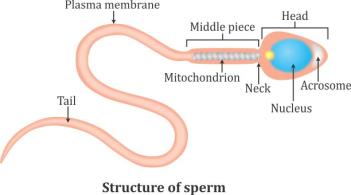
Q26. Draw
a labelled diagram of the microscopic structure of a human sperm.
Solution
Microscopic structure of a
human sperm
Q27. What is meant by LH surge? Write the role of LH.
Solution
Rapid secretion of LH
leading to its maximum level during the mid-cycle is called LH surge. It
induces rupture of Graafian follicle and thereby the release of ovum
(ovulation).
Q28. From
where parturition signals arise, mother or foetus? Mention the main hormone
involved in parturition.
Solution
Parturition signals arise from the foetus and placenta. Oxytocin
is the main hormone involved in parturition.
Q29. ‘Each and every coitus
does not result in fertilisation and pregnancy’. Justify the statement.
Solution
It is important that the
ovum and sperm reach simultaneously to the ampullary-isthmic junction. As
most of the sperms and ova fail to do so, each and every coitus does not
result in fertilisation and pregnancy.
Q30. Placenta
acts as an endocrine tissue. Justify
Solution
Placenta
secretes hormones such as human chorionic gonadotrophic (hCG), estrogen,
progesterone and human placental lactogen. So, placenta is regarded as an
endocrine tissue.
Comments
Post a Comment