Q1. What is meant by monosporic development of female gametophyte?
Solution
When the female gametophyte (embryo sac) develops from a single megaspore, it is called monosporic development.
Usually, in most angiosperms, the megaspore mother cell divides by meiosis to form four haploid megaspores arranged in a linear fashion. The three haploid megaspores situated towards the micropyle degenerate, while one remains functional which develops into the female gametophyte.
Q2. “Incompatibility is a natural barrier in the
fusion of gametes”. Justify the statement.
Solution
1. Nature has developed
both structural as well as chemical barriers which restrict fertilisation in organisms.
2. Chemical
incompatibility of pollen prevents fertilisation
between unrelated plant species.
3. Structural barriers
like placement of anthers and stigma at different positions prevent self
pollination and promote cross pollination.
Q3. Name the type of flower which favours cross-pollination.
Solution
The
flowers which favour cross-pollination are chasmogamous flowers. They develop exposed anthers and
stigma.
Q4. Even though each pollen grain has two male gametes,
why are at least 10 pollen grains and not 5 pollen grains required to
fertilise 10 ovules present in a particular carpel?
Solution
Even though each pollen grain has two male gametes,
atleast 10 pollen grains required to fertilise 10 ovules present in a
particular carpel instead of 5 pollen grains because only one male gamete is
involved in syngamy or the fusion of male gamete with the egg cell.
Q5. In the same species of Asteraceae and grasses, seeds are formed without the fusion of
gametes. Mention the scientific term for such a form of reproduction.
Solution
In the
same species of Asteraceae and
grasses, seeds are formed without the fusion of gametes. This form of
reproduction is called apomixis.
Q6. If the diploid number of chromosomes in an
angiospermic plant is 16, mention the number of chromosomes in the endosperm
and antipodal cell.
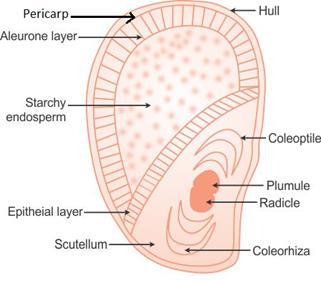
Solution
The
diploid (2n) number of chromosomes in an angiospermic plant is 16. So, the
number of chromosomes in endosperm (3n) is 24 and that in antipodal cells
(2n) is 16.
Q7. How will you go about increasing
the population of a certain plant introduced into a new environment which
neither produces seeds nor responds to vegetative propagation?
Solution
We can increase the
population of a certain plant introduced into a new environment which neither
produces seeds nor responds to vegetative propagation by using artificial
techniques like tissue culture, meristem culture etc.
Q8. Why is the process of fertilisation
in a flowering plant referred to as double fertilisation? Explain.
Solution
Fertilisation in flowering plants is referred to as double
fertilisation because both the male gametes of the
same microspore take part in fusion. One fuses with the egg to form the
diploid zygote, and the other fuses
with the two polar nuclei (or secondary nuclei) to form the triploid primary
endosperm nucleus.
Q9. Some
plants have a mechanism of shedding of pollen before the maturation of
stigma. Why?
Solution
Some
plants have a mechanism of shedding of pollen before the maturation of stigma to prevent self-pollination.
Q10. Mention the reasons for the difference in ploidy of zygote
and primary endosperm nucleus in an angiosperm.
Solution
Zygote is formed by
syngamy, so it is diploid in nature, and primary endosperm nucleus is formed
by the fusion of
secondary diploid nucleus with one of the male gamete, so it is triploid in
nature.
Q11. Draw a labelled diagram of
the sectional view of a mature pollen grain in angiosperms. Explain the
functions of its different parts.
Solution
Structure of mature
pollen grains in angiosperms.
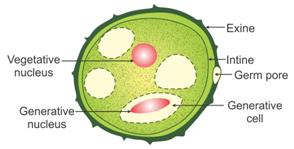 Functions of the parts of
pollen grain: A mature pollen grain has a two-layered wall—the outer exine
and inner intine. The wall encloses a large vegetative cell containing
vegetative nucleus and a lenticular generative cell. Their functions are as
follows:
1. Exine: The outer thick
exine layer is made up of sporopollenin which is resistant to physical and
biological decomposition. It provides protection during the hazardous journey
of pollen from the anther to stigma. There are one or many germ pores on the
pollen surface which are directly or indirectly associated with its
germination.
2. Intine: The intine is
pecto-cellulosic in nature. It is associated with the formation of the pollen
tube.
3. Vegetative cell: The
vegetative cell is large and contains abundant food reserve. It has a large
vegetative nucleus.
The function of the vegetative cell is to provide the medium for the movement
of male gametes inside the pollen tube.
4. Generative cell: The generative
cell cytoplasm is highly reduced but it contains the usual cell organelles.
It
divides mitotically to produce two functional male gametes.
Functions of the parts of
pollen grain: A mature pollen grain has a two-layered wall—the outer exine
and inner intine. The wall encloses a large vegetative cell containing
vegetative nucleus and a lenticular generative cell. Their functions are as
follows:
1. Exine: The outer thick
exine layer is made up of sporopollenin which is resistant to physical and
biological decomposition. It provides protection during the hazardous journey
of pollen from the anther to stigma. There are one or many germ pores on the
pollen surface which are directly or indirectly associated with its
germination.
2. Intine: The intine is
pecto-cellulosic in nature. It is associated with the formation of the pollen
tube.
3. Vegetative cell: The
vegetative cell is large and contains abundant food reserve. It has a large
vegetative nucleus.
The function of the vegetative cell is to provide the medium for the movement
of male gametes inside the pollen tube.
4. Generative cell: The generative
cell cytoplasm is highly reduced but it contains the usual cell organelles.
It
divides mitotically to produce two functional male gametes.
Functions of the parts of
pollen grain: A mature pollen grain has a two-layered wall—the outer exine
and inner intine. The wall encloses a large vegetative cell containing
vegetative nucleus and a lenticular generative cell. Their functions are as
follows:
1. Exine: The outer thick
exine layer is made up of sporopollenin which is resistant to physical and
biological decomposition. It provides protection during the hazardous journey
of pollen from the anther to stigma. There are one or many germ pores on the
pollen surface which are directly or indirectly associated with its
germination.
2. Intine: The intine is
pecto-cellulosic in nature. It is associated with the formation of the pollen
tube.
3. Vegetative cell: The
vegetative cell is large and contains abundant food reserve. It has a large
vegetative nucleus.
The function of the vegetative cell is to provide the medium for the movement
of male gametes inside the pollen tube.
4. Generative cell: The generative
cell cytoplasm is highly reduced but it contains the usual cell organelles.
It
divides mitotically to produce two functional male gametes.
Q12. The microscopic pollen grains of the past are obtained as
fossils. Mention the characteristic of pollen grains that makes it happen.
Solution
The outer exine layer of pollen grains is coated with wax
and sporopollenin which is hard and not easily
degraded by micro-organisms. This property of exine causes the pollen grains
to stay intact in its fossilised form.
Q13. Give reasons why
(i) Most zygotes in angiosperms divide only after certain amount of endosperm is formed.
(ii) Groundnut seeds are exalbuminous and castor seeds are albuminous.
(iii) Micropyle remains as a small pore in the seed coat of a seed.
(iv) Integuments of an ovule harden and the water content is highly reduced as the seed matures.
(v) Apple and cashew are not called true fruits.
Solution
(i) Endosperm is the food laden tissue formed during the development of angiospermous seed which provides essential nutrients to the growing embryo and also the young seedling at the time of seed germination. So, most zygotes in angiosperms divide only after certain amount of endosperm is formed.
(ii) The seeds in which the endosperm is used up are called exalbuminous seeds. In groundnut, the endosperm is used and the reserve food material is stored in cotyledons. So, groundnut seeds are exalbuminous. The seeds having ample amount of endosperm tissue are called albuminous seeds. Castor seeds have persistent endosperm. So, castor seeds are albuminous.
(iii) Double fertilisation in angiosperms brings about some changes in the ovule during the development of seed. The micropyle remains in the form of a fine pore on the surface of seed to allow the entry of water during seed germination.
(iv) Integuments of an ovule harden and the water content is highly reduced as the seed matures to ensure the survival of seeds.
(v) The fruit derived from the ovary of a flower not associated with any non-carpellary part is called a true fruit. In apple and cashew, the main edible part of the fruit is the fleshy receptacle. So, they are not true fruits. Such fruits derived from the ovary along with other accessory floral parts are called false fruits.
Q14. Outer envelope of a pollen grain is made of a highly
resistant substance. What is that substance and at which particular point is
it absent?
Solution
The outer envelope of a pollen grain is made of a highly resistant
substance called sporopollenin. Sporopollenin is absent at the germpore.
Q15. In angiospermic plants, before formation of
microspore the sporogenous tissue undergoes cell division.
(a) Name the type of cell division.
(b) What would be the ploidy of the cells of tetrad?
Solution
(a) The type of cell division involved is meiosis or meiotic division.
(b) The cells of the tetrad would be haploid in nature.
Q16. Give the scientific name of a plant which came to
India as a contaminant with imported wheat and caused pollen allergy.
Solution
Parthenium, which
is a noxious weed, came to India as a contaminant with
imported wheat and caused pollen allergy.
Q17. Which is the triploid tissue in a
fertilized ovule? How is the triploid condition achieved?
Solution
Endosperm is the triploid
tissue formed by the primary endosperm nucleus containing cell resulting from
the
fusion of the secondary nucleus with the nucleus of one of the male gametes
of pollen grain.
Q18. Among the animals, insects particularly bees are the
dominant pollinating agents. List any four characteristic features of
insect-pollinated flowers.
Solution
Characteristic features of insect-pollinated
flowers:
1. Flowers are large.
2. Colourful petals of flower.
3. Presence of fragrance.
4. Rich in nectar.
Q19. Banana is a parthenocarpic fruit
whereas oranges show polyembryony. How are they different from
each other with respect to seeds?
Solution
Banana fruits are seedless. Such
fruits are called parthenocarpic, i.e., they produce embryo without fertilisation.
The seeds of oranges have many
embryos of different sizes and shapes. The orange seeds develop many embryos
due to polyembryony.
Q20. Why are pollen grains produced in enormous quantity
in maize?
Solution
Pollen
grains are produced in enormous quantity in maize to ensure pollination as
maize is pollinated by wind.
Q21. Mention the pollinating agent of an inflorescence of small dull coloured flowers with well exposed stamens and large
feathery stigma. Give any one characteristic of pollen grains produced by
such flowers.
Solution
Small dull coloured flowers do not
attract insects and birds. Therefore, these flowers produce large amount of
small pollen grains which are dispersed in air and stick to large feathery
stigma, Such flowers are thus, wind-pollinated.
Q22. Draw
a longitudinal section of a post-pollinated pistil showing the entry of
pollen tube into a mature embryo sac. Label the filiform apparatus, chalazal
end, hilum, antipodals, male gametes and secondary nucleus.
Solution
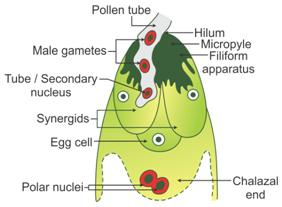
Longitudinal
section of a post-pollinated pistil showing the entry of pollen tube into a
mature embryo sac.
Q23. In a young anther, a group of compactly arranged
homogenous cells were observed in the centre of each microsporangium. What is
the name given to these cells?
Solution
Sporogenous tissue comprises of compactly arranged homogenous cells
observed in the centre of each microsporangium.
Q24. (a) Draw a labelled longitudinal view of an albuminous
seed.
(b) How are seeds advantageous to flowering plants?
Solution
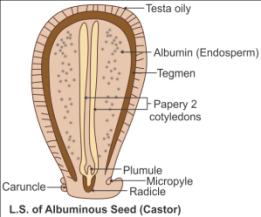
(a) Longitudinal view of
an albuminous seed
 (b) Seeds contain food to
nourish the embryo during germination and possess better adaptive strategies
for dispersal to new habitats. These are formed by sexual reproduction with
new variations and better genetic combinations. So, the seeds advantageous to
flowering plants.
(b) Seeds contain food to
nourish the embryo during germination and possess better adaptive strategies
for dispersal to new habitats. These are formed by sexual reproduction with
new variations and better genetic combinations. So, the seeds advantageous to
flowering plants.
(b) Seeds contain food to
nourish the embryo during germination and possess better adaptive strategies
for dispersal to new habitats. These are formed by sexual reproduction with
new variations and better genetic combinations. So, the seeds advantageous to
flowering plants.
Q25. A
bilobed and dithecous anther has 100 microspore mother cells per
microsporangium. How many male gametophytes can it produce?
Solution
Each
microsporangium has 100 microspore mother cells which form 400 microspores by
meiosis (100 × 4).
In
an anther, there are four microsporangia. So, the total number of microspores
will be 4 × 400 = 1600.
As
each microspore forms one male gametophyte, 1600 male gametophytes can be
produced.
Q26. Pollen grains of water-pollinated species have a
special characteristic for protection from water. Which is this
characteristic?
Solution
Pollen
grains of water-pollinated species show the presence of mucilaginous covering
which offers them protection from water.
Q27. An anther with a malfunctioning
tapetum often fails to produce viable male gametophytes. Why?
Solution
Male gametophytes remain inviable
because a malfunctioning tapetum cannot provide proper and adequate nutrition
for microspore development. So, an anther with a malfunctioning tapetum often
fails to produce viable male gametophytes.
Q28. ‘Dehydration
of seed increases their shelf life’—Explain.
Solution
Dehydration reduces the
water content and thus, minimises the metabolic activities that take place
inside the seed which increases the shelf life of seeds.
Q29. Explain
the process of artificial hybridisation to get
improved crop variety in:
(i) plants bearing bisexual flowers (ii) female parent producing
unisexual flowers.
Solution
If
a plant breeder desires to cross a particular plant with desired pollen
grains, a bisexual flower is artificially transformed into a female flower by
removing its stamens in bud condition without affecting the female
reproductive organs. This process is called emasculation.
The
emasculated flower is immediately enclosed in a bag to prevent pollination by
unwanted pollen. This process is called bagging. Then, mature and viable
pollen grains are collected from the male parent, the bag is opened and the
pollen grains are dusted on the stigma. The bag is replaced immediately.
The
technique of emasculation is applied only when artificial pollination is
carried out in a bisexual flower. If the female parent produces unisexual
flowers, emasculation is not needed. The unisexual flower is bagged before
the flowers open.
Q30. Differentiate between microsporogenesis and megasporogenesis.
What type of cell division occurs during these events? Name the structures
formed at the end of these two events.
Solution
Microsporogenesis: Process of formation of
microspore from the pollen mother cell.
Megasporogenesis: Process of formation of megaspore
from megaspore mother cell.
Meiotic division occurs in both the events.
Microsporogenesis results in the formation of pollen
grains, while megasporogenesis results in the formation of megaspores.
Q31. Trace
the development of microsporocyte in the anther to a mature pollen grain.
Solution
As
the anther develops, the cells of the sporogenous tissue undergo meiotic
divisions to form microspore tetrads. As each cell of the sporogenous tissue
is capable of giving rise to a microspore tetrad, each one is a potential
pollen or microspore mother cell. The process of formation of microspores
from a pollen mother cell (PMC) through meiosis is called microsporogenesis.
As the anthers mature and dehydrate, the microspores dissociate from each
other and develop into pollen grains. Inside each microsporangium, several
thousands of microspores or pollen grains are formed that are released with
the dehiscence of the anther.
Q32. Name the cell from which the
endosperm of coconut develops. Give the characteristic features of endosperm
of coconut.
Solution
Endosperm of coconut
develops from primary endosperm cell which divides repeatedly to form a
triploid endosperm tissue.
The endosperm of coconut
is made up of coconut water which is free-nuclear stage and white kernal is
cellular endosperm.
Q33. The flowers
of brinjal are referred to as chasmogamous
while that of beans are cleistogamous. How are they
different from each other?
Solution
Flowers of brinjal are similar to flowers of other species where
anthers and stigma are exposed. Such flowers
are called chasmogamous flowers. On the other hand,
the flowers of beans remain closed to ensure self-pollination. Such flowers
which remain closed so that cross-pollination does not occur are called cleistogamous flowers.
Q34. Mention two strategies evolved
to prevent self-pollination in flowers.
Solution
Cross-pollinating flowers
develop the following strategies to prevent self-pollination :
1. Protogyny
(when gynoecium matures earlier than androecium) or Protandry (when androecium matures and sheds pollen before maturation of gynoecium)
2. Self incompatibility
Q35. Arrange the following in the correct developmental
sequence:
Male gamete, potential pollen mother cell, sporogenous
tissue, pollen grains, microspore tetrad.
Solution
Sporogenous tissue  potential pollen mother cell microspore
tetrad pollen grains male gamete.
potential pollen mother cell microspore
tetrad pollen grains male gamete.
potential pollen mother cell microspore
tetrad pollen grains male gamete.
Q36. Name the common function
that is performed by cotyledons and nucellus.
Solution
Nutrition is provided to the embryo by cotyledons and the
embryo sac by nucellus, respectively.
Q37. (a) Draw a schematic labelled diagram of a
fertilised embryo sac of an angiosperm.
Solution
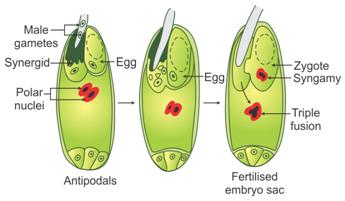
(a) Fertilised embryo sac of an angiosperm
Q38. Draw a vertical section of
a maize grain and label
(i) pericarp (ii)
scutellum (iii) coleoptiIe and (iv)
radicle.
Solution
Vertical section of maize
grain
Q39. Why
pea flowers produce assured seed sets? Give reasons.
Solution
Pea
flowers produce assured seed sets because they are cleistogamous,
autogamous and homogamous.
Hence, self-pollination occurs before the flowers open up at maturity.
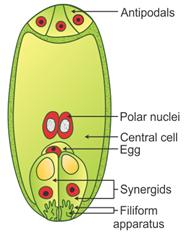
Q40. (a) Draw the embryo sac of a flowering plant and
label:
(i) Central cell.
(ii) Chalazal end.
(iii) Synergids.
(b) Name the cell that develops into an embryo sac
and explain how this cell leads to the formation of embryo sac.
(c) Mention the role played by the various cells of the
embryo sac.
(d) Give the role of filiform apparatus.
Solution
(a) Embryo sac of a flowering plant.
 (b) Functional megaspore.
The nucleus of the functional megaspore divides
mitotically to form two nuclei which move to opposite poles and form the
2-nucleate embryo sac.
(c) Egg: Fuses with the male gamete to form zygote
or the future embryo.
Synergid: Absorption of nutrients, attracts and
guides the pollen tube.
Central cell: After fusion with the second male
gamete, it forms the primary endosperm cell which gives rise to the endosperm.
(d) The filiform apparatus guides the entry of
pollen tube into the embryo sac.
(b) Functional megaspore.
The nucleus of the functional megaspore divides
mitotically to form two nuclei which move to opposite poles and form the
2-nucleate embryo sac.
(c) Egg: Fuses with the male gamete to form zygote
or the future embryo.
Synergid: Absorption of nutrients, attracts and
guides the pollen tube.
Central cell: After fusion with the second male
gamete, it forms the primary endosperm cell which gives rise to the endosperm.
(d) The filiform apparatus guides the entry of
pollen tube into the embryo sac.
(b) Functional megaspore.
The nucleus of the functional megaspore divides
mitotically to form two nuclei which move to opposite poles and form the
2-nucleate embryo sac.
(c) Egg: Fuses with the male gamete to form zygote
or the future embryo.
Synergid: Absorption of nutrients, attracts and
guides the pollen tube.
Central cell: After fusion with the second male
gamete, it forms the primary endosperm cell which gives rise to the endosperm.
(d) The filiform apparatus guides the entry of
pollen tube into the embryo sac.
Comments
Post a Comment