Q1. Mention the
effect of global warming on the geographical distribution of stenothermals
like amphibians.
Solution
Due to global warming, stenothermals like amphibians
would either migrate or die due to change in the temperature.
Q2. Write about
the 3R technology in waste management.
Solution
We can follow the 3R approach - reduce, reuse and
recycle - for effective waste management.
Reduce: One can reduce the amount of solid waste at
the source itself. Example: Use of less paper and less plastic
carry bags.
Reuse: One
can use plastic bottles and jars, aluminium foils and plastic bags over and
over again, before recycling or disposing them of.
Recycle:
Used and discarded materials like plastic, glass, paper and metal are sent to
the respective industries, where they can be converted into other useful
products.
Q3. State the
differences between biodegradable and non-biodegradable wastes.
Solution
Differences between biodegradable and
non-biodegradable wastes:
Biodegradable wastes
Non-biodegradable wastes
1. These wastes can be broken down into
non-poisonous substances by the action of microorganisms like bacteria and
earthworms.
1. These wastes cannot be broken down into
harmless substances by any biological processes.
2. Biodegradable substances change their form and
structure over time and become harmless.
2. Non-biodegradable substances remain unchanged
over a long period of time.
3. They do not pollute the environment.
3. Some of them remain inert and begin to
accumulate in our surroundings, while others cannot be made less toxic
easily and hence keep on polluting the environment.
Examples: Spoilt food, vegetable peels, tea
leaves, wood, grass, paper, leather, cotton, cattle dung etc.
Examples: Glass bottles, metal cans, polythene
bags, synthetic fibres, radioactive wastes, plastics and pesticides like
DDT etc.
Q4. Describe
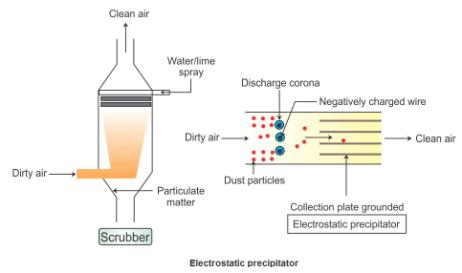
electrostatic precipitator by a diagram.
Solution
Electrostatic
precipitators are extremely efficient devices which remove about 99% of
particulate matter present in the industrial and thermal power exhausts. They
have charged plates which are connected to the ground. The electrode wires
are provided with high voltage electric current which produce a corona that
releases electrons. These electrons attach to the dust particles giving them
a negative charge. The collecting particles are grounded and attract the
charged dust particles. The velocity of air between the plates must be low
enough to allow the dust to fall.
Q5. Name any three
gases contributing to the greenhouse effect.
Solution
Carbon
dioxide (CO2), nitrous
oxide (N2O) and
methane (CH4) are
greenhouse gases which contribute to the greenhouse effect. These gases are
transparent to sunlight but can trap the heat and keep the Earth’s surface
warm.
Q6. DDT content
in the water of a lake which supplies drinking water to nearby villages is
0.003 ppm. The kingfishers of that area were reported to have 2 ppm of
DDT. Why has the concentration of DDT increased in these birds? What harm
will this cause to the bird population? Name the phenomenon.
Solution
DDT is a
toxic substance which gets accumulated in the organisms at each trophic level.
As it cannot be metabolised or excreted, the concentration of DDT increases
at each trophic level. As kingfishers are present at the highest trophic
level, the concentration of DDT is highest in them. The high concentration of
DDT disturbs calcium metabolism in birds, causes thinning of eggshell and
their premature breaking, and
eventually, causes a decline in the bird population. The phenomenon is called
biomagnification.
Q7. What are
radioactive elements? How do radiations affect the body cells?
Solution
Elements which emit radiations as they disintegrate
are called radioactive elements. Examples: Radium, thorium and uranium.
Non-ionising radiations inactivate biochemicals
including DNA and RNA. Ionising radiations break up the macromolecules.
Q8. What is polyblend? Why did plastic manufacturers
think of producing polyblend? Write its usefulness.
Solution
Polyblend is a fine powder of recycled modified
plastic. It was produced by plastic manufacturers in order to recycle plastic
waste. When blended with bitumen, polyblend can be used to lay roads which have
increased road life.
Q9. How is snow
blindness caused in humans?
Solution
The cornea of the human eye
absorbs UV-B radiation. High dose of UV-B can cause inflammation of the cornea
called snow blindness. Such exposure may permanently damage the cornea.
Q10. What is an ozone shield?
Solution
The thin layer of ozone which surrounds the Earth’s atmosphere and prevents harmful UV rays from reaching the Earth’s surface is called the ozone shield.
Q11. What is the
Amrita Devi Bishnoi Wildlife Protection Award given for?
Solution
The Amrita Devi Bishnoi Wildlife Protection Award is
given to individuals or communities from rural areas which have shown
extraordinary courage and dedication in protecting wildlife.
Q12. Why is it
desirable to use unleaded petrol in vehicles fitted with catalytic
converters?
Solution
The presence of lead in petrol inactivates catalysts
such as platinum, palladium and rhodium which convert harmful pollutants like
CO, unburnt hydrocarbons and nitric oxide into lesser harmful pollutants like
C02, H20 and N2.
Q13. Mention how
e-waste is produced and disposed of. Write the solution for its treatment.
Solution
Discarded electrical appliances such as old
television sets, computers, radios, mobile phones, fluorescent tubes, medical
instruments, toys and lead acid batteries all fall into the category of
e-wastes. E-wastes are either buried
in landfills or incinerated. Recycling under skilled supervision is the only
solution for the treatment of e-wastes.
Q14. How can
pollution by auto exhaust be minimised?
Solution
Pollution by auto exhaust can be minimised by
taking the following steps:
(i) Use of CNG as a fuel instead of petrol and diesel.
(ii) Use of
catalytic converter in vehicles.
(iii) Use
of lead-free petrol.
(iv) Use of
multipoint fuel injection engine.
Q15. Thermal power plants are inevitable in an industrial
and densely populated country. What harm do they do to the environment? Also,
mention any precaution which could be taken to save our environment.
Solution
Thermal power plants release particulate and gaseous
pollutants into the air which cause harmful effects. These pollutants can
cause:
(i) Breathing or respiratory problems when inhaled.
(ii) Irritation, inflammation and damage to the
lungs and premature death.
Precautionary measures to save the environment include
the use of electrostatic precipitators, which remove about 99% of the
particulate matter from the exhaust.
Q16. Why is CNG
considered a better fuel than diesel for automobiles?
Solution
CNG is
considered as a better fuel than diesel for automobiles because it burns most
efficiently, is cheaper and cannot be emptied by thieves and adulterated like
petrol or diesel.
Q17. What is meant by an ozone hole?
Solution
Depletion of the ozone layer widely in the stratosphere, particularly over the Antarctic region, resulted in the formation of a thinned ozone layer called the ozone hole.
Q18. Name any four
toxic compounds found in defunct ships.
Solution
The toxic compounds found in defunct ships include
asbestos, polychlorinated biphenyls (PCB), tributylin (TBT) and mercury.
Q19. What is
integrated organic farming?
Solution
Integrated organic farming is a cyclical, zero-waste
procedure, where waste products from one process are cycled in as nutrients
for other processes.
Q20. How do
automobiles fitted with catalytic converters reduce air pollution? Suggest
the best fuel for such vehicles.
Solution
Catalytic converters have expensive metals like
platinum, palladium and rhodium as catalysts. As exhaust emission passes
through the catalytic converter, unburnt hydrocarbons are converted into
carbon dioxide and water, while carbon monoxide and nitric oxide are changed
to carbon dioxide and nitrogen gas. Unleaded petrol is the best fuel for
automobiles fitted with catalytic converters to reduce air pollution.
Q21. Why is Eichhornia crassipes regarded as ‘Terror of Bengal’?
Solution
Eichhornia crassipes is an aquatic weed which grows fast and abundantly in water bodies with excess of nutrients and causes an imbalance in the water ecosystem. It results in oxygen depletion causing eutrophication, leading to the death of aquatic life.
Q22. Why are
lichens regarded as pollution indicators?
Solution
Lichens are
regarded as pollution indicators because they are sensitive to sulphur
dioxide (SO2) and do not grow
in polluted areas. Their presence indicates the absence of pollution in an area,
and their absence indicates that the area is polluted.
Q23. Which is
the most common and abundant greenhouse gas? Discuss the effect of this gas
on the growth of plants.
Solution
Carbon dioxide is the most common and abundant (60%)
greenhouse gas. As the concentration of carbon dioxide increases, the growth
of plants increases by 30% in a short period. At higher concentration of CO2,
stomata close, and hence, the rate of transpiration gets reduced.
Q24. Why is
nuclear waste said to be an extremely potent pollutant?
Solution
The radiations emitted by nuclear waste are
dangerous to organisms as they can cause mutations at a high rate. At high
doses, nuclear radiation is lethal, but at lower doses, it creates various disorders
such as cancer. Therefore, nuclear waste is said to be
an extremely potent pollutant.
Q25. Explain how solid waste can be disposed of.
Solution
Different ways of solid waste disposal are
1. Waste segregation: At the
household level, the wastes are first separated into dry and wet solid
wastes. The wastes are then stored in separate containers.
2. Composting: The rotting and conversion of organic
waste into manure is known as composting. The household garbage as well as
farmland wastes can all be converted into useful compost.
3. Vermicomposting :
The method which involves the use of worms to decompose the wastes is called
vermicomposting. The earthworms can degrade or decompose the wastes such as
domestic waste, cow dung, coconut thresh etc. in few days.
4. Secured landfill: Secured landfill is the best disposal option for solid wastes,
particularly, hazardous wastes. It prevents leaching of waste.
5. Deep well injection method: A well is drilled
into the dry porous material below the groundwater. Hazardous waste liquids
are pumped into the well. They soak into the porous material and, in this
way, remain isolated indefinitely.
6. Pyrolysis: The process of pyrolysis transforms hazardous organic materials into
gaseous components, small quantities of liquid and coke. It is possible to
generate gas and electricity through the process of pyrolysis.
7. Incineration: Hazardous biomedical wastes, such as
discarded medicines, toxic drugs, human anatomical wastes, blood, pus,
microbiological and biotechnological wastes etc., are usually disposed of by
incineration. It helps to reduce the weight and volume of waste and converts
these toxic wastes into less toxic or even non-toxic substances.
8. Recycling: E-wastes can be recycled in
specifically built facilities or manually to recover important metals.
Q26. State the difference between radioactive waste and municipal
solid waste.
Solution
Difference between radioactive waste and municipal
solid waste
Radioactive waste
Municipal solid waste
1. Waste of nuclear energy which are non-usable
and possess radioactivity are called radioactive waste.
1.
Waste generated from domestic, industrial and commercial activities is
called municipal solid waste.
2. Radiations emitted from nuclear wastes can
cause mutations and extreme damage to organisms.
2. Radiations are not emitted from municipal solid
waste.
3. Radioactive wastes are generally disposed of in
secured landfills and through the deep well injection method.
3. Municipal solid
wastes are generally disposed of in sanitary landfills, through pyrolysis
and incineration.
Examples: Leftovers of nuclear material used in the
production of electricity, for diagnosis and treatment of disease and for other
purposes.
Examples: Paper, leather, textile, rubber, glass
etc.
Q27. (a) What is
El Nino effect? Explain how it accounts for biodiversity loss.
(b) Explain
any three measures which you as an individual would take to reduce
environmental pollution.
Solution
(a) The El Nino effect refers to uneven climatic changes
due to rise in temperature. It leads to increased melting of polar ice caps
as well as other places like the Himalayan snow caps. This results in the rise
in the sea level which can submerge many coastal areas, thus resulting
in biodiversity loss.
(b) Measures to reduce environmental pollution:
(i) Use of renewable energy resources
(ii) Use of television and other instruments at low
pitch
(iii) Minimum use of fossil fuels
(iv) No tobacco smoking
(v)
Planting more trees
Q28. State the
major causes of air pollution in metro cities. Write any three ways in which
it can be reduced.
Solution
The major
causes of air pollution in metro cities are
(i) Smoke
from forest fires, volcanic eruptions etc.
(ii)
Decomposition of garbage resulting in the release of unwanted gases into the
atmosphere.
(iii)
Burning of fossil fuels in automobiles and industries release particulate air
pollutants.
(iv) Use of
unleaded petrol.
(v) Gaseous
waste or particulate by-products of various industries.
Control measures
of air pollution:
(i) Use of
electrostatic precipitators to remove particulate matter from industries and
thermal power plants.
(ii) Use of
scrubber to remove gases like S02.
(iii) Use of catalytic converters in automobiles to reduce
the emission of poisonous gases.
Q29. (a) What
depletes ozone in the stratosphere? How does this affect human life?
(b) Explain
biomagnification of DDT in an aquatic food chain. How does it affect the bird
population?
Solution
(a)
Chlorofluorocarbons (CFCs) are mainly responsible for the depletion of ozone
in the stratosphere. Once released in the troposphere, CFCs reach the stratosphere and
produce ‘active chlorine’ in the presence of ultraviolet (UV) radiation. These
radicals, through a chain reaction, destroy the ozone by converting it into
oxygen. Excess dose of UV-B
radiations damages DNA causing mutation, skin cancer, snow blindness,
cataract and ageing of skin.
(b) If DDT
leaches from agricultural fields, it enters the nearby water body. The concentration
of DDT in the water body is low (0.003 ppm). The pesticide enters the food
chain and gets accumulated in zooplankton (0.04 ppm) and thereby its
concentration goes on increasing at different trophic levels of the food
chain from the small fish (0.5 ppm), large fish (2 ppm) to finally the fish-eating
birds (5 ppm). Concentration of DDT increases along the food chain, reaching the
highest level in the top carnivore bird. The increased concentration of DDT
in birds disturbs calcium metabolism. The egg shells become thin, resulting
in premature breaking. Consequently, there is a decline in the bird
population.
Q30. What was the purpose of the concept of Joint Forest Management (JFM)?
Solution
The Government of India in 1980s introduced the concept of Joint Forest Management (JFM) so as to work closely with the local communities for the protection and management of forests. In return, the communities got the benefit of various forest products such as fruits, gum, rubber, medicine etc. In this way, the forest can be conserved in a sustainable manner.
Comments
Post a Comment