Q1. For which variety of Indian rice was a patent
filed by a USA Company?
Solution
Indian
Basmati crossed with a semi-dwarf variety was claimed as a new variety, for
which the patent was filed by a USA company.
Q2. What is legally wrong in the US patent law?
Mention the common items of biopiracy.
Solution
US patent law does not recognise
technologies and methods in use to other countries as 'prior past'. The
common items of biopiracy are soil micro-organisms plants, animals and their
genetic material.
Q3. How does a transgenic organism differ from the
rest of its population? Give any two examples of such organisms for human
advantage.
Solution
A transgenic organism contains functional
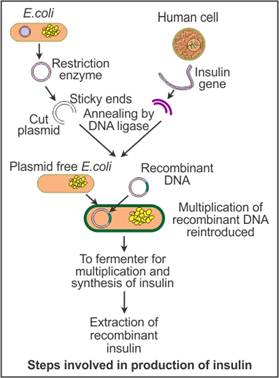
foreign gene experimentally introduced into their genome by genetic
engineering from another species. Hence, it differs from the rest of the
population in having one or more extra genes apart from the gene pool of that
population.
Examples of transgenic organisms:
(i) Transgenic E. coli with gene for human insulin
(ii) Transgenic mice with gene for human growth
hormone
Q4. Biopiracy should be prevented. State why and
how.
Solution
Biopiracy refers to the use of
bioresources by multinational companies and other organisations without
proper authorisation from the countries and people concerned without
compensatory payment. It can be prevented by developing laws to obtain proper
authorisation and by paying compensatory benefits.
Q5. List three molecular diagnostic techniques that
help detect pathogens from suspected patients. Mention one advantage of these
techniques over conventional methods.
Solution
Molecular diagnostic techniques that help to
detect pathogens from suspected patients are:
(a) Recombinant DNA technology
(b) Polymerase chain reaction (PCR)
(c) Enzyme linked immune sorbent assay (ELISA)
These techniques are better than the
conventional methods because they help in early diagnosis of the disease and
give precise results even when the bacteria or virus concentration is very
low.
Q6. How can bacterial DNA be released from the bacterial
cell for biotechnology experiments?
Solution
For biotechnology experiments, the
bacterial cell wall is digested by the enzyme lysozyme to release DNA from
the cell.
Q7. (i) Give the scientific name of the
soil bacterium which produces crystal (Cry) proteins.
(ii) How are these proteins useful
in agriculture?
(iii) What do the differently written terms
'Cry' and 'cry' represent
respectively?
Solution
(i) Bacterium Bacillus thuringiensis produces crystal (Cry) proteins.
(ii) Cry proteins are toxic to
certain larvae of insects and thus, provide resistance from them. The gene
encoding Cry proteins are incorporated in several crop plants (Bt toxin). Such
a crop plant is resistant to the particular insect pest.
(iii) Cry represents crystal
protein while cry refers to the gene encoding the cry protein.
Q8. You have identified a useful gene
in bacteria. Make a flow chart of the steps that you would follow to transfer
this gene to a plant.
Solution
After
identifying a useful gene in bacteria, following steps should be undertaken
to transfer the gene to a plant:

Q9. What was the speciality of the milk produced by
the transgenic cow Rosie?
Solution
The first transgenic cow Rosie,
produced milk with human alpha-lactalbumin which was nutritionally a more
balanced product for human babies than natural cow milk.
Q10. How does RNA interference help in developing
resistance in tobacco plant against nematode infection?
Solution
A nematode Meloidegyne incognitia infects the roots of tobacco plants which
reduce the production of tobacco. The infection can be prevented using RNA
interference (RNAi) process which is checked by silencing of specific mRNA
due to a complementary ds RNA. The ds RNA binds and prevents translation of
the mRNA. By using Agrobacterium
vectors, nematode-specific genes were introduced into the host plants which
produce both sense and antisense RNA in the host cells. These two RNAs are
complementary to each other and form a double stranded RNA (ds RNA) that
initiates RNAi and hence, silences the specific mRNA of the nematode. The parasite
cannot survive in transgenic host and so, prevents the plants from pests.
Q11. Describe the responsibility of GEAC set up by
the Indian Government.
Solution
GEAC
(Genetic Engineering Approval Committee) was set up by the Ministry of
Environment and Forests to regulate research, testing and commercial release
of GM crops, foods and organisms.
The
objectives of GEAC are:
1.
To permit the use of GM
organisms and their products for commercial purposes
2. To adopt procedures for
restriction, production, scale, import, export and applications of GM
organisms
3. To approve for conduct
of large scale field trials and release of transgenic crops in the
environment
4. To authorise agencies or
persons to have large scale production and release of GM organisms into the
environment or curb and take strict actions against them
Q12. Highlight any four advantages of genetically
modified organisms (GMOs).
Solution
Advantages of genetically modified organisms
(GMOs):
(i) Tolerant to abiotic stresses (cold,
drought, salt, heat)
(ii) Reduces reliability on chemical pesticides
(iii) Reduces post-harvest losses
(iv) Increases efficiency of mineral usage by
plants
Q13. What are the conditions for which patent is
given?
Solution
Government
grants patent to certain inventors as permission to use invention for commercial
purpose.
Patent
is given for the following reasons:
1.
For producing new product or invention
2.
Modified or improved earlier invention
3.
Technical know how
4.
New designing concept
Q14. Why is the gene encoding for Cry protein inserted into a crop
plant?
Solution
The gene encoding for Cry protein is inserted into a crop plant
to provide resistance against insect larvae.
Q15. Name any five transgenic plants and their
potential applications.
Solution
Some transgenic plants and their potential
applications are given below:
Transgenic plants
Applications
1. Bt cotton
Resistance
to bollworm infestation, tolerance to herbicide, high yielding
2. Golden rice
Rich in vitamin A
3. Brassica
napus
Contains hirudin that prevents blood clotting
4. Flavr Savr tomato
Better nutrient quality and longer shelf life
5. Maize
Herbicide resistance
Q16. Write two uses of PCR technique in molecular diagnosis.
Solution
Two uses of PCR technique in
molecular diagnosis:
(i) It is used to detect HIV in
suspected AIDS patients.
(ii) It is used to detect mutations
in the gene of suspected cancer patients.
Q17. How do interferons protect us?
Solution
Interferons protect non-infected
cells from further viral infections by creating cytokine barriers. They also
inhibit cellular proliferation and modulate the immune system of the
organism.
Q18. How did Eli Lilly Company go about preparing
human insulin? How is this insulin produced different from that produced by
the functional human insulin gene?
Solution
Eli Lilly prepared two DNA
sequences corresponding to A and B chains of human insulin and introduced
them in plasmids of E.coli to
produce insulin chains. Chains A and B were produced separately, extracted
and combined by creating disulphide bonds to form human insulin. Insulin in
human pancreas is synthesised as a pro-hormone containing the C peptide,
which is removed in mature hormone. The insulin synthesised by recombinant
DNA technology did not contain C peptide and was prepared in the mature form.
Q19. What are transgenic animals? Explain any four
ways in which such animals can be beneficial to humans.
Solution
The organisms which contain
functional foreign genes experimentally introduced into their genome by
genetic engineering from another species are called transgenic animals.
Benefits of transgenic animals:
1. Study of normal physiology and development:
Transgenic animals are useful to study gene regulation, their effect on the
normal functioning of the body and its development.
2. Study of diseases: Transgenic models have
been developed for many human diseases like cancer, cystic fibrosis,
rheumatoid arthritis and Alzheimer’s disease.
3. Vaccine safety: Transgenic mice have been
developed to test the safety of vaccines before they are being used on
humans.
4. Chemical safety testing: Transgenic animals
are made to carry genes which make them more sensitive to the toxic
substances than non-transgenic animals. On exposure to the toxic substances,
their effects can be studied in a lesser time.
Q20. Differentiate between PCR and gene cloning.
Solution
Differences between PCR and gene
cloning
PCR
Gene cloning
1. It is a
process of making a number of copies of a particular gene segment
1. It is a
process of forming multiple identical copies of a particular template DNA
2. Requires
DNA as the main substrate
2. Requires
restriction enzyme, ligase, vector, bacterial cells as the main substrates
3.
Automation is present
3.
Automation is absent
4. Less
expensive
4. Highly
expensive
5. Has less
applications
5. Has more
applications
6. Less
error probability
6. More
error probability
7. Skilled
labour is not required
7. Skilled
labour is required
Comments
Post a Comment